
Most counter organization systems fail within about ten days. Not because the baskets were wrong or the labels weren’t pretty enough, but because the system solved a Pinterest problem instead of the household’s actual problem. A tray that looks perfect on day one becomes a junk collection point by day twelve if it wasn’t built around how the counter is really used.
That’s really the starting point for any lasting fix: counters get cluttered because they’re doing several jobs at once — food prep, mail sorting, charging station, coffee bar, kids’ homework drop zone — and most kitchens were never designed with that many functions in mind. The goal isn’t to make the counter look empty. It’s to give every one of those jobs its own small, defined space so nothing has to compete for the same six inches of laminate.
Start By Naming the Actual Problem Zones
Before buying a single organizer, it helps to walk the counter and note where things actually pile up, rather than guessing. In most kitchens, clutter concentrates in four or five predictable spots.
The landing zone. This is wherever keys, mail, sunglasses, and loose receipts get dropped the moment someone walks in. It’s rarely the whole counter — usually just the stretch nearest the door.
The prep strip. The area beside the stove or sink that should be clear for chopping and plating but slowly fills with utensils, spice jars, and cutting boards left mid-task.
The small appliance cluster. Toaster, kettle, coffee maker, air fryer — all useful, all bulky, and all competing for the same corner.
The paperwork drift. School forms, takeout menus, warranty booklets, and the odd screwdriver that “just needs somewhere for now.”
The charging corner. Phones, tablets, and cables, usually tangled together near the only accessible outlet.
Once these zones are identified, the fix stops being about buying storage and starts being about assigning each zone a boundary it isn’t allowed to cross.
Solving the Landing Zone
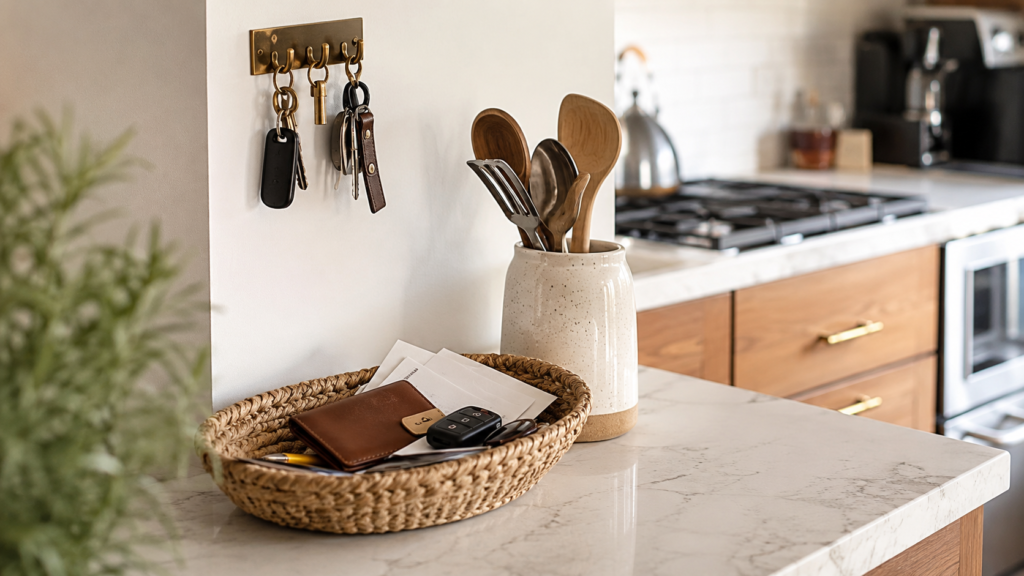
The landing zone clutters fastest because it has no natural stopping point — items get set down “for a second” and stay for a week. A shallow tray or a small dish, placed exactly where people already drop things, tends to work better than moving the landing zone somewhere more convenient in theory but ignored in practice. Fighting existing habits rarely wins; working with them usually does.
A wall-mounted key hook directly above the tray removes one more category of loose item from the counter entirely, and it’s a five-minute installation rather than a renovation.
Quick Win
If mail is the biggest offender, a standing file sorter takes up less counter footprint than a flat tray and forces papers into an upright, visible stack instead of a spreading pile — visible clutter gets dealt with faster than clutter that’s easy to ignore.
Solving the Prep Strip
This is the zone worth protecting most aggressively, since a blocked prep strip is what usually pushes cooking-related mess onto every other surface in the kitchen.
A narrow utensil crock, sized to hold only the tools used daily rather than the entire drawer’s contents, keeps this area functional without sprawling. Anything used less than once a week belongs in a drawer, not on display — a rule that sounds obvious but is one of the most commonly ignored in kitchen organizing.
Wall-mounted magnetic strips for knives free up a surprising amount of counter length, particularly in narrower galley kitchens where every inch of prep space matters.
Budget Tip
A repurposed ceramic mug or a thrifted crock does the same job as a designed utensil holder at a fraction of the cost. The function matters more than the branding here.
Solving the Small Appliance Cluster
Small appliances are the hardest category to organize because most of them genuinely need to stay accessible — hiding the coffee maker in a cabinet only works if someone’s actually willing to pull it out every morning, and most people aren’t.
A dedicated appliance shelf, even a narrow one added below existing cabinetry, moves daily-use machines up and off the counter without removing them from easy reach. Where that’s not possible, grouping appliances onto a single tray — rather than letting each one claim its own patch of counter — visually consolidates the cluster into one “station” instead of several scattered items.
Appliance garages, a small tambour-door cabinet built specifically to conceal counter appliances, are a worthwhile addition in a full renovation but rarely make sense as a retrofit purely for organization purposes.
Mini Comparison
- Appliance tray: Fast, cheap, works in any kitchen, but doesn’t reduce visual clutter much.
- Appliance shelf below cabinets: Moderate cost, frees real counter space, requires drilling.
- Appliance garage: Highest cost, cleanest result, only realistic during a larger renovation.
Solving the Paperwork Drift
Paper clutter multiplies faster than almost anything else on a counter because there’s rarely a clear rule for where any given piece of paper “belongs.” A simple three-tier system — act on it, file it, recycle it — placed in a small wall-mounted rack solves most of this, but only if it’s checked weekly. An organizer without a maintenance habit attached to it just becomes a slower-filling version of the same pile.
Designer Note
Vertical storage almost always outperforms flat storage for paper. A flat tray invites stacking, and stacks are easy to ignore. An upright slot forces a decision the moment something is added.
Solving the Charging Corner
Tangled cables are one of the fastest ways a counter starts to look messy even when everything else is tidy. A small charging station — even something as simple as a shallow box with a cutout for the cord — keeps devices contained to one six-inch footprint instead of spreading across the whole counter.
Where an outlet isn’t near the ideal spot, a slim power strip with a built-in cable clip solves the problem without an electrician. It’s a small investment that resolves one of the most persistently annoying clutter sources in the kitchen.
Material Guide: What to Organize With
Not every organizing material suits every kitchen, and matching the material to the room’s finishes makes the system feel intentional rather than improvised.
- Woven baskets and rattan trays suit warmer, more traditional kitchens and hide visual mess well, though they’re harder to wipe down near the stove.
- Powder-coated metal trays wipe clean easily and suit more modern kitchens, but show fingerprints more readily than woven materials.
- Marble or stone trays feel higher-end and pair well with stone countertops, though they add weight and cost more than most alternatives.
- Clear acrylic organizers are useful specifically for the paperwork and charging zones, since visibility helps prevent the “out of sight, forgotten” pile.
A Weekly Maintenance Habit Worth Building
Even a well-designed system needs a reset point, or it slowly drifts back to where it started. A five-minute “Sunday reset” — clearing the landing tray, filing anything from the paperwork rack, and wiping the prep strip — tends to be enough to keep a counter system functional long-term. Systems that rely on daily perfection usually fail faster than systems built around one consistent weekly check-in.
Common Mistakes Worth Avoiding
Buying storage before identifying the problem zone. A beautiful basket in the wrong spot on the counter just becomes a beautiful container for clutter.
Over-organizing rarely-used items. Spending effort corralling the ice cream maker used twice a year distracts from fixing the daily landing-zone pileup that actually bothers the household.
Choosing organizers that don’t match daily habits. A closed box for keys that get tossed on the counter out of habit will get ignored in favour of the counter itself, no matter how nice the box is.
A Small Challenge Worth Trying
For one week, resist buying any new organizing product. Instead, simply place a single tray, bowl, or box in whichever zone causes the most daily frustration, and track whether it actually gets used. If it does, that’s the zone worth investing more in. If it’s ignored, the problem likely isn’t a lack of storage — it’s a habit mismatch worth solving differently.
Where This Leaves Things
A genuinely organized counter isn’t one that stays empty — it’s one where every item has an obvious, low-effort place to return to. The kitchens that stay tidy long-term usually aren’t the ones with the most storage solutions. They’re the ones where each solution was matched carefully to a real, observed habit instead of an aspirational one.