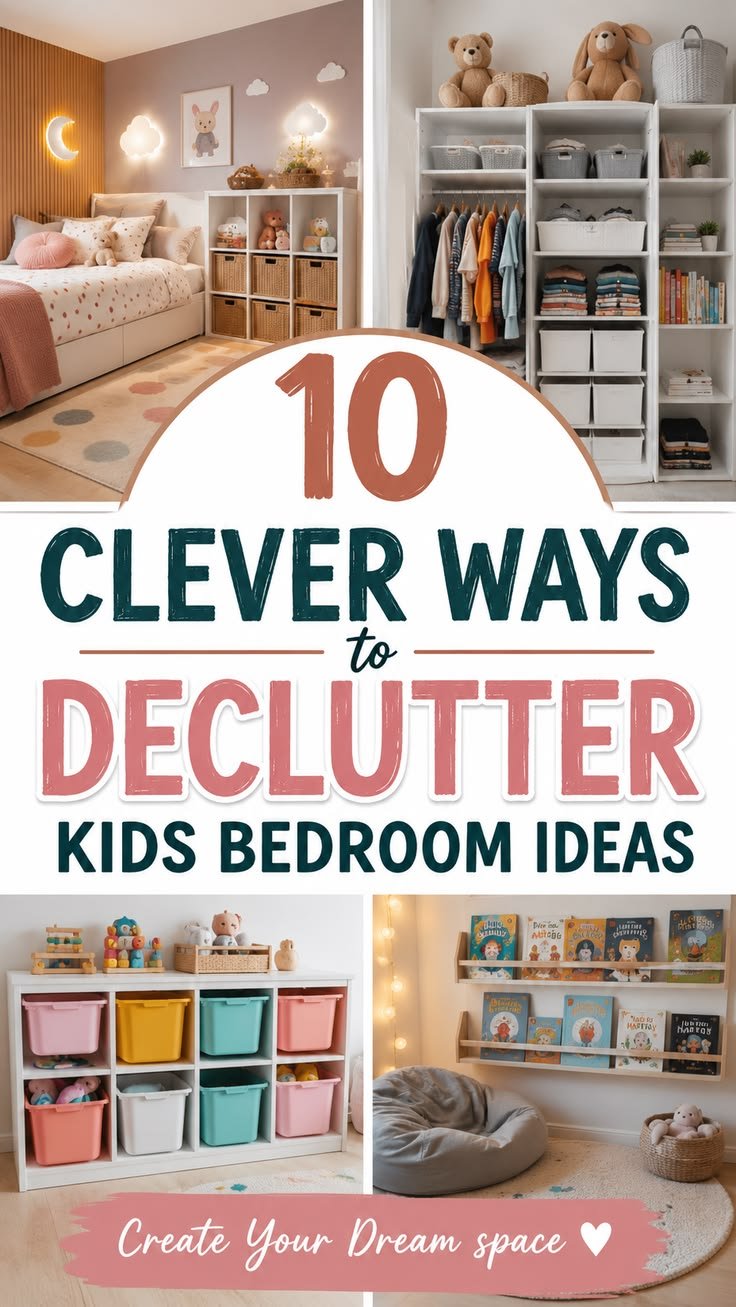
A pile of stuffed animals spills off the bed. Three odd socks sit near the door. A half-built Lego set balances on the windowsill, waiting for a hand that won’t come back to it for weeks. If this sounds like your child’s room on a Tuesday afternoon, you’re not dealing with a messy kid — you’re dealing with a room that was never set up to handle how a child actually lives in it.
Kids don’t clutter rooms out of carelessness. They clutter rooms that don’t give them an easy place to put things back. Adults organise by category. Children organise by “where’s the nearest open spot,” which is exactly why a beautifully arranged bookshelf can look chaotic again within a day. The fix isn’t more willpower from a seven-year-old. It’s a layout that works with their habits instead of against them.
This walkthrough moves zone by zone through a typical kids’ bedroom — floor, closet, bed, desk, walls and toy storage — with a workable idea for each one. Along the way you’ll find a few short detours: a designer note, a quick win, a common mistake worth avoiding, and a budget-friendly swap. By the end you’ll have ten ideas that fit together as a system, not just a list.
Zone One: The Floor and Entry Area
The floor is usually the first casualty in a cluttered kids’ room, mostly because it’s the only surface within reach of small arms.
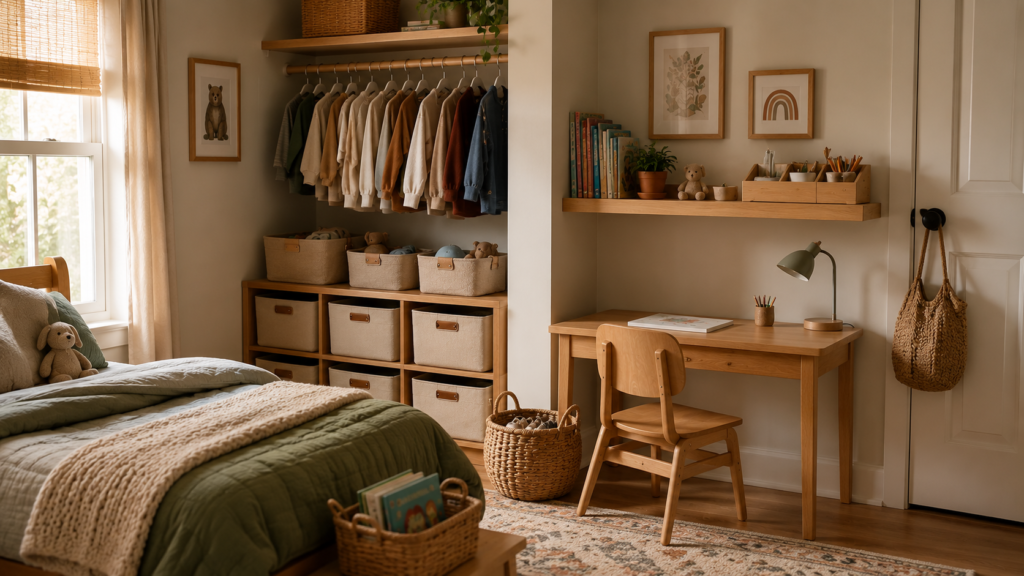
1. A low, open basket line near the door. Set two or three soft baskets right where your child enters the room. One for shoes, one for bags or sports kits, one for “stuff I’m currently obsessed with.” The rule is simple: if it’s not in a basket, it goes back to its real home. Baskets at floor height work far better than shelves, since a toddler or young child won’t lift a bin onto a shelf but will happily drop something into an open basket at knee height.
2. A designated drop zone for daily-use items. Backpacks, water bottles, library books — anything that leaves the house daily needs its own hook or shallow tray by the door. Many compact bedrooms benefit from combining this with a small bench, so the drop zone doubles as a place to sit and change shoes.
Designer Note: Floor clutter is rarely a storage problem. It’s a distance problem. If the “correct” spot for an item is more than a few steps and one extra decision away, it won’t get used consistently, no matter how nice the container is.
Zone Two: The Closet
Closets in kids’ rooms are often built for adult proportions, which means half the space sits empty above a child’s head while the floor below fills up with everything else.
3. A second, lower hanging rod. Adding a rod at child height — roughly knee to chest level — lets kids hang up their own clothes instead of leaving them on the floor “for later.” This single change does more for daily tidiness than any bin system, because it removes the excuse that hanging clothes was too hard to reach.
4. Labelled bins sorted by activity, not category. Instead of “shirts” and “socks,” try bins labelled “school,” “sports,” and “weekend.” Kids sort by what they’re doing, not by garment type, so activity-based labels get used more consistently than strict category ones.
Quick Win: Swap wire hangers for slim felt or plastic ones sized for kids. Clothes stay on the rod instead of sliding off, which quietly prevents a good portion of closet-floor pileups.
Zone Three: The Bed and Under-Bed Storage
The bed eats up a large footprint in most kids’ rooms, so it’s worth making that space earn its keep twice over.
5. Bed risers with slide-out drawers or bins underneath. Raising the bed frame by a few inches opens up a surprising amount of storage for out-of-season clothing, spare bedding, or bulky toys that don’t need daily access. Clear bins here work better than opaque ones, since kids can see what’s inside without pulling everything out to check.
6. A bedside reading basket instead of a stacked pile. Books tend to migrate onto the mattress and stay there. A shallow basket beside the bed gives them a landing spot that’s just as easy to reach but doesn’t take over the sleeping surface.
One common mistake here is using under-bed storage for everyday toys. Anything stored under the bed becomes, functionally, invisible — kids forget it exists within a week, and it turns into a black hole rather than active storage. Reserve that space for items used monthly or seasonally, not daily.
Zone Four: The Desk or Study Corner
A cluttered desk is one of the fastest ways for a child to lose interest in homework or quiet activities altogether.
7. A vertical desktop organiser instead of flat trays. Paper, pencils and craft supplies pile up fast on flat surfaces. Standing organisers — the kind with slots rather than open trays — keep the desk usable because items have to be placed upright, which naturally limits how much can accumulate before it looks messy.
8. A rotating supply caddy for shared or frequently swapped materials. If your child uses different supplies for different hobbies (drawing one week, model-building the next), a caddy that can be lifted and moved works better than a fixed drawer system. One shelf, one caddy, one rule: only current-project supplies stay out.
Budget Tip: A cutlery organiser tray from a kitchenware aisle is often cheaper than a dedicated “desk organiser” and does the same job for pens, erasers and small craft tools.
Zone Five: Walls and Vertical Space
Floor space in a kids’ room is almost always in short supply, but wall space is usually underused.
9. Floating shelves or a pegboard above the desk or dresser. Vertical storage takes clutter off the floor without shrinking the room’s usable space. A pegboard in particular works well for kids because it’s endlessly reconfigurable — hooks and small shelves can move as interests change from dinosaurs to art supplies to sports gear.
| Wall Storage Option | Best For | Trade-off |
|---|---|---|
| Floating shelves | Books, display items, folded clothes | Needs adult supervision for reaching items |
| Pegboard | Frequently changing hobby supplies | Requires drilling; not renter-friendly without adapters |
| Wall pockets/fabric organisers | Small toys, art supplies | Less durable long-term than solid shelving |
Choosing between these often comes down to whether the room needs flexibility (pegboard) or a simple display of favourite items (shelves).
Zone Six: Toys and Seasonal Rotation
Toys are usually the largest single category of clutter, and also the one parents feel most reluctant to touch.
10. A toy rotation system with two or three storage bins kept out of sight. Instead of trying to fit every toy your child owns into the room at once, keep a portion visible and store the rest in a closet, garage, or under-bed bin. Swap them every few weeks. This isn’t about owning fewer toys — it’s about never asking one small room to display all of them simultaneously. Most children re-engage with a “new” rotated toy more than they would with the tenth item added to an already full shelf.
Styling Formula: Visible toy storage + one rotating bin + one open floor basket for whatever’s currently in play = a room that resets in under ten minutes.
Keeping It That Way: A Simple Maintenance Ritual
None of the above holds up without a light routine behind it. A short nightly reset — five to ten minutes before bed, ideally done together at first — tends to work better than a big weekend cleanup. Rooms that only get organised once a week usually drift back to chaos by Wednesday, while rooms with a nightly reset rarely get bad enough to need a deep clean at all.
A seasonal check every few months is worth adding too: clothes that no longer fit, toys that haven’t left the rotation bin in two cycles, and school papers that piled up in the desk organiser are the usual culprits worth clearing out.
Frequently Asked Questions
How many toys should stay out at once in a small bedroom? There’s no fixed number, but a useful test is whether your child can see most of what’s available without digging. If a bin needs to be dumped out to find anything, it’s holding too much for daily access.
Should decluttering happen with or without the child present? Both approaches have a place. Sorting alongside your child builds decision-making skills and reduces resistance later, while a quick adult-only pass works better for very young children who aren’t yet able to make those calls confidently.
What’s the best age to introduce a labelled bin system? Most children can follow simple picture or colour-coded labels from around age three, with text labels becoming useful once reading skills develop, usually by six or seven.
Is it worth buying matching storage bins for a polished look? Matching bins photograph well, but mismatched containers that fit the space properly will outperform a matching set that doesn’t. Function first, colour coordination second.
Bringing the Zones Together
A decluttered kids’ bedroom rarely comes from one big overhaul. It comes from six or seven small systems working at once — a basket by the door, a lower rod in the closet, a rotation bin for toys — each one solving a specific habit rather than trying to force a tidier child. Start with whichever zone causes the most daily frustration in your home, get that one working smoothly, and the rest tend to follow with far less effort than expected.